In this article
A familiar company name does not tell you which system produced a message, what the message proves or whether it applies to your situation. Start by separating those questions.
The public map is a starting point
Allied Universal’s Earn More page describes LISA’s Claim a Shift and My Shift Offers, links to lisa.aus.com and says users can opt into shift-offer texts. Its login directory identifies eHub as an employee route for schedules, pay stubs and contact information. The Mercury Personal Edition page describes another app route and separates Enhanced features available at selected sites. These are descriptions of purpose, not evidence that every feature is enabled for every worker.
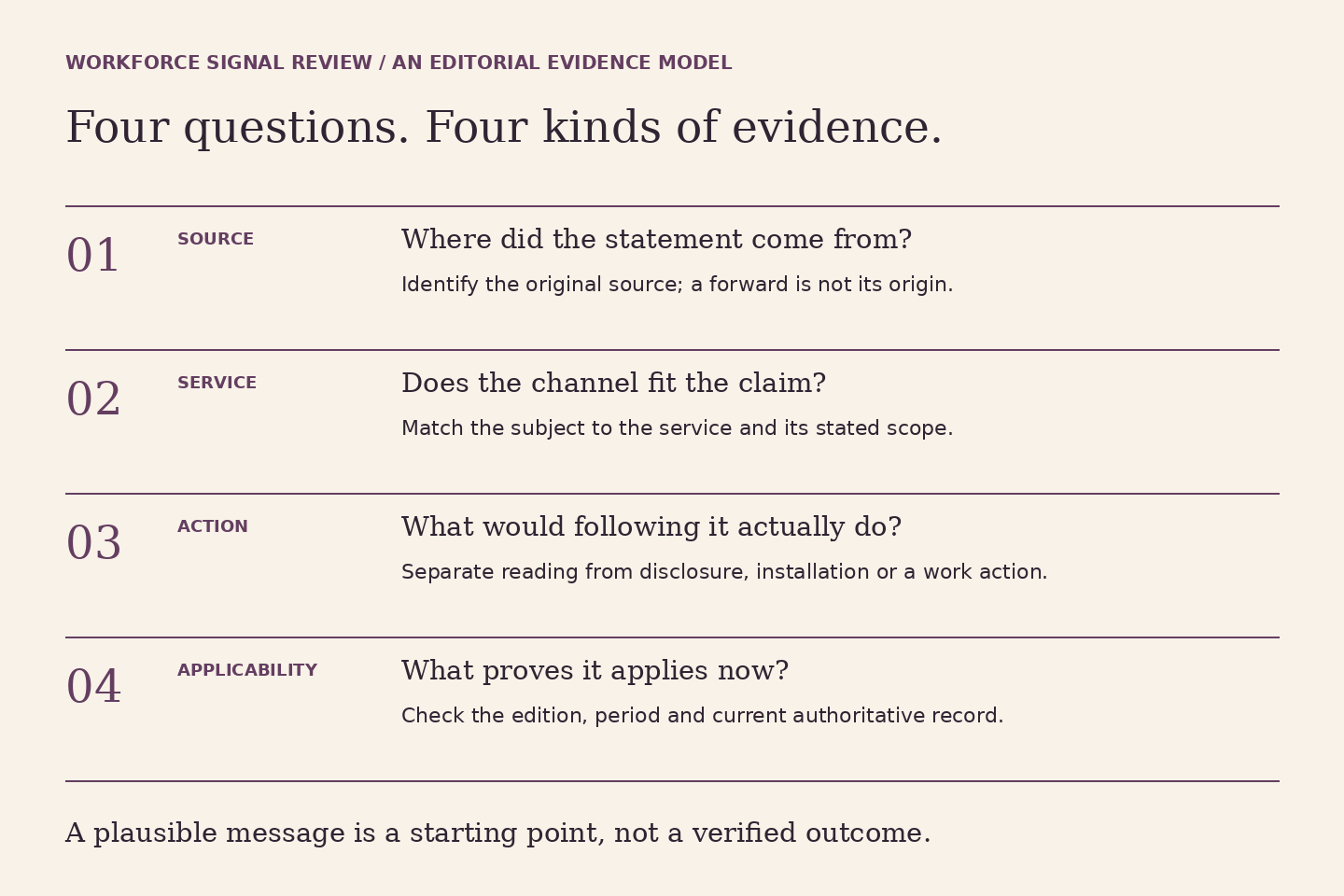
Four things a message can establish
- Source
- You can identify where you encountered the statement. A forwarded image establishes only that someone sent you an image; it does not establish its origin.
- Purpose
- The statement may describe an available feature or ask for an action. A description of a feature is weaker evidence than the current record of your own transaction.
- Applicability
- The statement may refer to a particular edition, location, time or account. Those conditions must travel with the claim.
- Outcome
- An actual result needs its own evidence. A notification that an opportunity exists is not proof that a later action succeeded.
Use the product name as a question
Suppose a fictional coworker says, “It is all in the app.” Ask which app, which section and what they actually observed. They might mean a schedule view, an offer notification, a company announcement or an instruction from a manager. Treating these as interchangeable can hide the point where the evidence changes.
A useful question is: “Which current employer record should I use to verify this specific change?” It is more answerable than “Which app is correct?” The latter asks someone to rank entire systems. The former asks them to identify the record responsible for a decision.
Do not infer that LISA, Mercury and eHub share every setting merely because their uses overlap. The public pages reviewed do not establish universal synchronization timing, message delivery guarantees, a common notification switch or a single status vocabulary. A person can recognize the company’s public route without knowing how a particular account is configured.
Read the address independently
The official Earn More page links to lisa.aus.com. The public LISA destination returned a JavaScript application shell during our source review. That verifies a linked public destination, not its signed-in menus, current availability or the state of any employee’s account.
When deciding where to go, use a company page you reached independently. Do not treat a screenshot, display name, copied logo or text that merely contains an address as a verification of the actual destination. You do not need to send this publication a message or account identifier to perform that check.
A bounded outcome
After using the map, you should be able to say: “This is the public source describing the channel, this is the claim I still need to verify, and this is the kind of employer record that could resolve it.” You should not conclude that a message is genuine merely because its subject fits the channel.
For an unexpected message, continue with the authenticity review. For two conflicting notices, use the comparison method. Both preserve the distinction between a plausible explanation and verified evidence.
SOURCE NOTES / OCTOBER 16, 2026
Evidence behind this article
Public-source reporting and editorial analysis. No private account was inspected. Worked cases are fictional.
- Allied Universal: Earn More. Your Way. — Public LISA shift features, text preferences and the official LISA destination.
- Allied Universal: Login Portal — The company-published eHub route and its stated employee uses.
- Allied Universal: Mercury Personal Edition — Public app overview, official store links and site-dependent Enhanced availability.
- Allied Universal: LISA Portal — Public destination linked by Allied Universal. Only a JavaScript application shell was readable; no authenticated functions were inspected.